


Your Strokes:
Kevin Bryant Forehand
Analyzed by John Yandell
Since he joined Tennisplayer last year, Kevin has been one of our most avid and active subscribers, and has also helped spread the word about the site to a lot of other players and coaches. This is actually the second version of his forehand he's sent me to look at on video. Based on that I can tell you that Kevin has worked hard to improve his unit turn and the stretch of his left arm across the body. And it shows.
I also know Kevin has spent, shall we say, a 'substantial' amount of time on the site, reading about forehand technique, and also studying videos of the top players in the archives. He has been particularly fascinated by the swing pattern on the forehand and the variety of finishes you see with the top players.
In this issue Paul Lubbers has some interesting things to say about the pitfalls of copying the pros, and I have to say that I agree that there are dangers. (Click Here.) No I'm not saying that players shouldn't study the top players or that creating the Stroke Archive was some type of mistake. Definitely the opposite. Without these types of data bases, real progress in understanding technique is probably impossible. But for the average player, it's not always going to be a direct transfer of a pro's motion into your game.
When you study the pros with the idea of changing or improving your game, there are some critical questions. Who should you copy? How much can you copy? What are the critical aspects in producing the stroke yourself--in other words, what is a cause and what is effect? And finally, is the technical element I think I am copying appropriate for the my game and the specific ball I am trying to use it to hit?
This last question is the one that most applies in the case of Kevin's video. We've seen that hand and arm rotation are a critical variable in the pro forehand across the grip styles. (Click Here.) But how much rotation should you use when, with what grip style, and for what level player? As I told Kevin in an email, this is where a little knowledge can be a dangerous thing. When we look at his forehand, we can see why.
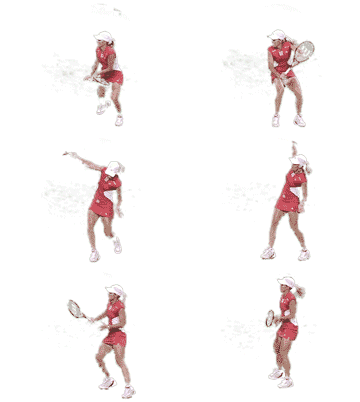
Take a look at the incredible range of his finishes. Kevin is right up there with Roger Federer, if not more versatile. He can finish on edge and in front, he can wrap over the shoulder, and he can hit a couple of versions of wiper finishes, turning his hand over as the racket moves across the body. The only problem is that Roger knows when to use them. All of Kevin's amazing finishes are on nearly identical medium pace balls in the center of the court. I know Kevin was working on a ball machine when he made the video. This is what made the balls so similar. I'll have to say it's the single largest range of swing variations I have ever seen under those circumstances. Well, that's an accomplishment, but not one that necessarily leads to a beter and more reliable forehand.
 |
 |
 |
More versatility is not necessarily the key, especially in basic swings. |
||
So the question is, should that kind of extreme hand rotation even come into play on that kind of ball? And obviously the answer is no. Now, let's be clear. I am not saying not to develop hand and arm rotation. You (and Kevin) definitely should. What I am saying is that you have understand the difference between your basic swing and how you adjust to circumstances where it may be appropriate.
Kevin appears to have a mild semi-western grip, or a 4 / 3, according to our new terminology. (Click Here.) That would correlate with a simple, vertical swing pattern on the basic balls around the baseline he's hitting in the video, similar to what we see with the Andre Agassi examples here. Andre may be officially retired, but he's still an incredible technical model.
The multiple variations Kevin is demonstrating in the video would be associated with very high balls, or very low balls. These balls that you usually have to play from wide positions, or in the forecourt, or on the run, or moving backwards. Sometimes you need that type of rotation in the center of the court, but this would usually be on balls hit with tremendous pace, where additional spin is a necessity to maintain control.
The fact is that varying the finish almost randomly on basic balls in the center of the court makes it very difficult, if not impossible, to develop a rhythmic swing pattern that you can count on to produce consistency, power, and depth on an automatic basis and under pressure.
 |
 |
Another look at Agassi's finishes. |
|
There's another problem too. We noted at the top that Kevin's turn was pretty solid with the left arm coming across the body and stretching out pretty well, at least on most balls. But check out the legs. The body is turning but there is no real knee bend or coil in the back leg. That coiling is every bit as important as the upper body movement. If we look at the timing of pro players, we can see that on a basic ball in the center of the court, these two elements occur at roughly the same time. I think Keven can work on imitating Agassi's position--coiling the rear leg and really stretching out that arm all the way.
This is something that is potential pitfall working on the ball machine, particularly with the machine set for too short an interval between the balls. Things just happens too fast and players get caught up in executing aspects--like the exotic variations in hand rotation. Then they forget about the hard basic work we all need to do with our legs to set up and hit the ball well.
So here is my advice to Kevin. Slow the interval down on that ball machine! It's not how many balls you hit, it's how well you hit them. Keep that turn--and make it even a little better. But make sure that when you turn, to add the coil in the back leg. Now standardize that basic ball finish, more like the first one in the series of still images above, but a little more relaxed. Andre is right there to be your model. Now, test your development. Can you hit 9 out 10 balls deep, solid, and crosscourt--and then do that 10 times in a row, all with the same finish?
When it comes to the hand rotation, create a feeding pattern with the ball machine that replicates balls where this would actually come into play. Not the most extreme versions , but balls where you can comfortably execute the pattern. For example, wider balls that bounce higher, shorter lower balls, etc. Start in the middle of the court and give yourself enough of an interval to move to them. Then widen it out.
Don't rotate just for the sake of believing that you really are Roger Federer. Find out how much rotation you need to make a specific shot, and then work the same kind of repetition drills until you have confidence in that specific pattern. Use the same amount of hand action on each ball and master that, then increase an increment. Don't make the same mistake of trying to randomly hit every shot in the book every other ball. When you've figured out all your variations, then and only then you can mix them--if you have that kind of advanced ball machine. But match the technical pattern to the tactical shot.