


Secrets of a True Master:
Two-Handed Backhand Balance Checkpoints
Welby Van Horn
|
|
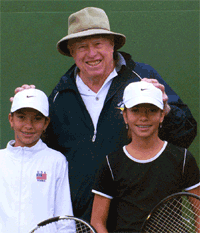
What Balance Means to Welby. Click Photo |
In the last article we outlined the balance checkpoints for the forehand. (Click Here.) Now we'll go through the exact same process for the two-handed backhand.
The checkpoints form the base for developing the stroke, helping you the jigsaw puzzle we
call the game of tennis. As with the forehand, if you really want to develop sound
fundamentals on your two-hander, it is critical to study and memorize the checkpoints.
Just reading about them in this article and then heading out to the
court will not be sufficient. Really mastering the checkpoints means two things. First,
being able to describe them accurately in words. Second being able to demonstrate them
with physical precision.
If you cannot verbalize the checkpoints and replicate them accurately when you swing without the ball, then you have not really learned them. It will be impossible to execute them in play. You will not have the proper foundation, and will be very unlikely to develop good balance.
Players are impatient and often don't want to spend the time and effort required. Instead they want to immediately hit balls. They equate this with "improvement." To my way of thinking that is a waste of time and energy. The real work is in teaching your body and your brain the fundamentals of the motion. Hitting all the balls in the world won't help you without that.
To master the checkpoints physically, it is very important to practice them in front of a mirror and to use slow motion practice. In fact this may be the most powerful way to teach yourself to really remember the checkpoints.
|
|
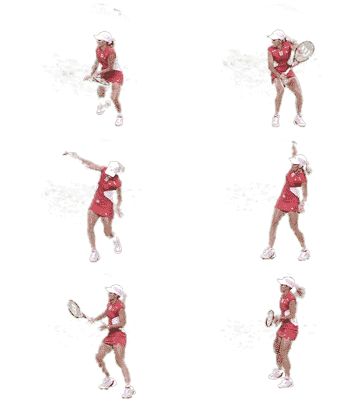
Use the Balance Checkpoints To Build Your Swing Without the Ball |
|
Learn to master the checkpoints by swinging without the ball. |
 |
1. Ready Position
The player faces the net. |
|
The Ready Position |
|
|
From: The Ready Position To: The Start of theTurn Sideways |
|
The sideways turning motion. |
 |
2. Start of Turn Sideways
The body and feet start to turn sideways. |
|
The Turn Sideways |
|
|
From: The Start of the Turn Sideways To: The Completion of the Turn Sideways
|
|
Completing the Turn. |
 |
3. Completion of the Turn Sideways The feet are now sideways and the shoulders and hips have continued to turn back. |
|
Completion of Sideways Turn |
|
|
From: The Completion of the Turn Sideways To: The Step Forward and the Beginning of Forward Rotation |
|
The step forward and the start of the body rotation. |

|
4. Step Forward and Beginning of Forward Rotation The front anchor foot steps towards the net in a square or
neutral stance, after the ball bounces but before the racket starts swinging forwards |
|
The Forward Step and the beginning of the forward rotation |
|
|
From: The Step Forward and the Beginning of Forward Rotation To: The Contact Point |
|
The movement to contact. |
 |
5. The Contact Point The hips have rotated forward 45 degrees from the sideways position. The weight is fully on front foot. |
|
The contact point on the Two-Hander |
|
|
From: The Contact Point To: The Continuation of the Forward Rotation |
|
From the Contact, the Forward Rotation continues. |
 |
6. Continuation of Rotation After Contact TThe hips and shoulders continue to rotate forward. |
|
The continuation of the forward rotation on the forehand. |
|
|
From: The Continuation of the Forward Rotation To: The Completion of the Forward Rotation |
|
The hips and shoulders finish their rotation. |

|
7. Completion of Forward Rotation The hips and shoulders have finished their rotation. The hips are facing
the net and have turned a full 90 degrees from the completion of the turn.
|
|
Completion of Forward Rotation |
That completes the checkpoints for the two-hander. Learn to describe them verbally and to swing the racket according to them. This will make your
understanding thorough and automatic. You will develop an outstanding foundation for balance on your two-hander.
Next we'll add
the checkpoints for the one-hander.