


The One-Handed Backhand:
Balance Checkpoints
Welby Van Horn
In previous articles we've talked about the general principles of balance on the groundstrokes. (Click Here) We've also presented the balance checkpoints for the forehand (Click Here) and the two-handed backhand.(Click Here).
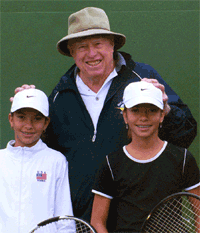
Now let's do the same for the one-handed backhand. These checkpoints give you the basic building blocks for learning the one-handed backhand within my system. A special thanks to my old student Joe Brandi, fine player and great coach, for demonstrating them for us, just as he learned them so long ago in Puerto Rico where I taught for most of my career.
The progression below is for developing a classical one-handed backhand with an eastern backhand grip. This is the grip John Yandell identifies as a 2 /1 grip. It's a mild, natural topspin drive. If we look at the top players in the world, we can see them using the same elements presented here in these teaching progressions. This includes players like James Blake and Roger Federer.
You will also see many of the same elements in the extreme grip players. Mastering this progression lays a foundation for developing a world class backhand whether you stay with a classic grip or progress to a more extreme grip over time. It gives the club player or the beginner a superb foundation for developing the same shot at any level.
As with the other strokes, t he checkpoints presented here will help you solve the jigsaw puzzle we call the game of tennis. It's one thing to talk about a stroke, another to learn to execute it. This is what my system will allow you do. I've proven it over decades with hundreds and hundreds of players from the beginning to world class levels.
For this reason, it is critical to study the checkpoints, memorize them, and learn them physically. This means being able to describe the checkpoints accurately in words, and execute them with precision. Just reading this article is not enough.
To master the checkpoints physically, it is very important to practice them in front of a mirror and to use slow motion practice. In fact this may be the most powerful way to teach yourself to really remember the checkpoints.
If you cannot verbalize the checkpoints and replicate them accurately when you swing without the ball, then you have not really learned them. It will be impossible to execute them in play. You will not have the proper foundation, and will be very unlikely to develop good balance and sound technical strokes.
 |
1. Ready Position Checkpoints: The player faces the net. |
|
The Ready Position |
|
|
From: The Ready Position To: The Start of theTurn Sideways |
|
The sideways turning motion. |
 |
2. Start of Turn Sideways
The player has turned the racket hand counter-clockwise to create the backhand grip. |
|
The Turn Sideways |
|
|
From: The Start of the Turn Sideways To: The Completion of the Turn Sideways
|
|
Completing the turn. |
 |
3. Completion of the Turn Sideways The feet are now sideways and the shoulders and hips have continued to turn back. |
|
Completion of Sideways Turn |
|
|
From: The Completion of the Turn Sideways To: The Step Forward and the Beginning of the Forward Swing |
|
The step forward and the start of the body rotation. |
 |
4. Step Forward and Beginning of Forward Swing The front anchor foot steps towards the net in a square or neutral stance. |
|
The Forward Step and beginning of the Forward Swing |
|
|
From: The Step Forward and the Beginning of Forward Swing To: The Contact Point |
|
The movement to contact. |
 |
5. The Contact Point The hips have rotated slightly forward from the sideways position. The weight is fully on front foot. |
|
The Contact Point |
|
|
From: The Contact Point To: The Continuation of the Forward Rotation |
|
From the Contact, the Forward Rotation continues. |
 |
6. Continuation of Swing After Contact The hips and shoulders have rotated slightly further forward. |
|
Continuation of the Forward Rotation |
|
|
From: The Continuation of the Forward Swing To: The Completion of the Forward Swing |
|
The hips and shoulders finish
their rotation
and the racket reaches the finish.
|
 |
7. Completion of Forward Swing The hips and shoulders finish only slightly past the perpendicular position to the net.
|
|
Completion of Forward Swing |
So that's it for the progression on the basic topspin drive. In the next article we'll look at the lost art of the slice drive. Stay tuned!