


Private Lessons:
Forehand Completion
By Scott Murphy

In Part One of this series we left you coiled, locked in, and poised to unleash the remainder of your forehand groundstroke. Again, using examples of the world's top pros, let's examine the essential elements necessary to keep the rest of your forward swing on the money.
Establishing the Contact Range
It is important to note that the catalyst for the forward swing (and the back swing) is the correct contact range. Nothing hinders your game more than failing to meet the ball comfortably out in front of you. This is what prompts the timing of the take back and forward swing. If done correctly, the entire process will be perfectly continuous, as seen in the Bjorn Borg animation. Notice how his forehand stroke flows from start to finish. Finding the most effective contact range for your forehand (or any stroke) will come through experimentation in practice, and the realization that your own sense of balance and leverage is your best guide.
Whether you are using an open stance or square stance on your forehand, make sure to create an "avenue" through which you make your forward swing. For the square stance step OUT to the ball, stepping across the body (closed stance), will prevent proper hip and trunk rotation, and risk crowding the shot. In other words, you won't be able to get your body out of the way. Remember for the open stance, keep your back foot to the inside of the ball, or you'll be forced to swing across your body instead of forward towards your target. Additionally, regardless of the stance, be sure to flex your knees when hitting the ball. Without knee flexion the upper body has to compensate for the loss of leverage resulting in a stroke that is off balance and ineffective.
The Wrist and Arm Position
The moment before the forward swing begins it is essential to lock your wrist and elbow in position. Lay the wrist back at an approximately 90 degree angle to the forearm, and bend the elbow so that another 90 degree angle is formed between the forearm and the upper arm. Maintaining this position to the point of impact and well beyond is a must, because it steadies the racquet head as it collides with the ball. The key to maintaining the locked in position is "to let the handle lead the strings". It's as if the butt of the handle and the heel of your hand are combining to pull the racquet head through the contact point and on into the follow through. If you're truly locked in and the BACK of the wrist initiates forward movement of the racket wherein the strings lead the handle, it's likely you're hitting late. All the more reason to work on that range of contact! More about that wrist break later.
The Role of the Non-dominant Arm
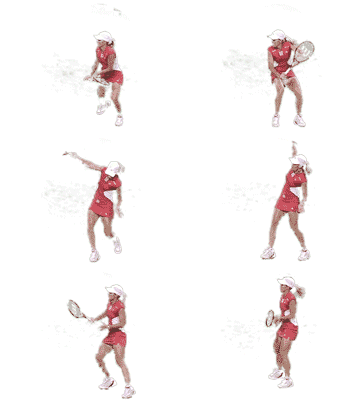
As the hips, trunk, and shoulders begin to rotate forward, make sure to keep your shoulders perfectly level to make a steadier more even swing. When striking the ball, the plane of your shoulders should be level and facing the target; however, one deterrent to this I often see is improper movement of the non-hitting arm. That arm has the role of "pace car" to the hitting arm's role of "race car", and in the process they should work commensurately. Notice in the sequence of Martina Hingis, how well synchronized her arms are from start to finish. I've seen so many players unaware of their non-hitting arm flying up in the air, or dropping like a lead weight and staying there, or scissoring across the body having started too far to the left (for a right hander), as well as other variations. These are counter productive to overall balance and can cause the racket to be out of sync with the force provided by the elastic action of the trunk.
The Follow Through
Finally, and I can't stress this enough, follow through, or in other words, HIT THROUGH THE BALL! I often see players end their swing prematurely (at the moment of impact), creating a floppy wristed finish. The fact is, a good deal of the swing takes place after the ball is hit, and so "following through" means driving the racket head well beyond the impact point. This will provide power and consistency, because pulling the racket ALL the way through the stroke prevents unwanted wristy errors.
A flowing, well-timed, well-balanced, and complete forehand can be a real weapon. Instead of fearing your forehand, develop a forehand your opponents will fear. Armed with the information above and in the previous article, the powerful images of the world's greatest players, and plenty of practice time, you'll be on your way to a forehand you can count on!